
Jul
The best pet loss gift is something that keeps the pet present rather than something that tries to move the person past them. Personalized keepsakes, a donation in the pet’s name, a framed photo, or practical help with meals and chores are the gifts grieving owners say they remember years later — and the ones that arrive weeks after the loss, when everyone else has stopped asking, tend to matter most of all.
We make handmade pet memorials in our workshop in Brampton, Ontario, which means a lot of our week is spent reading messages from people who have just lost a dog or a cat, or who are trying to find something for a friend who has. The same questions come up over and over. This is our attempt to answer them properly.
Is It Appropriate to Give a Gift When Someone’s Pet Dies?
Yes — and the hesitation behind that question is itself worth addressing.
Many people who lose a pet describe a specific kind of loneliness afterward: the grief feels enormous, but the world treats it as minor. Nobody sends flowers. There’s no time off work. Friends who would have shown up for a human funeral say nothing at all, usually because they’re worried that acknowledging it will seem like an overreaction.
So the risk runs the opposite way from what most people assume. Sending something imperfect is almost always better than sending nothing, because the message underneath any pet loss gift is I know this was a real loss. That’s the part that lands. The object is mostly a vehicle for it.
What to Give Someone Who Lost a Dog or Cat
Below are the categories that hold up best, roughly ordered from most to least personal.
1. A Personalized Memorial Keepsake
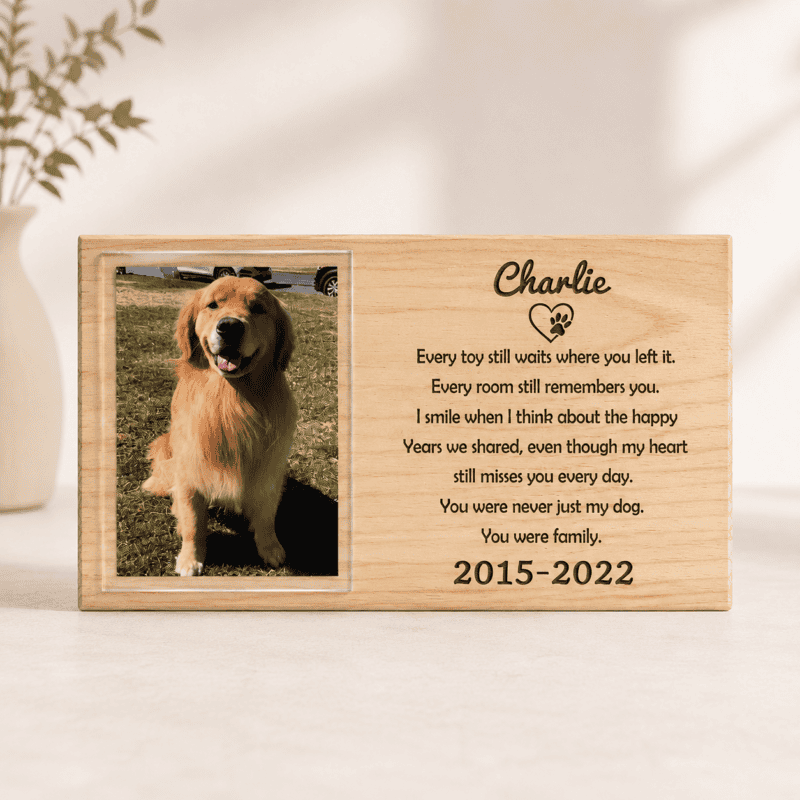
Something engraved with the pet’s name and years — a plaque, a frame, a garden stone, an ornament — gives the person a physical place for the grief to sit. Owners often describe a strange restlessness in the first weeks, where they keep looking for the dog in the spots the dog used to be. A keepsake gives them somewhere to look on purpose.
The version that works best includes a photograph, because a name alone can feel abstract while a face does not. Our own pet memorial picture frame was built around exactly that: a photo insert beside a laser-engraved name, dates, and verse. That said, the principle matters more than the maker — whatever you choose, look for something engraved or carved rather than printed, since printed keepsakes yellow and chip within a few years and a memorial is meant to outlast the grief.
2. A Donation in the Pet’s Name
A gift to a shelter, a rescue, or a veterinary fund in the pet’s name turns the loss into something that helps another animal. This is a particularly good option when you don’t know the person well enough to send something for their home, or when they’ve mentioned wanting fewer possessions rather than more. Ask the organization to send an acknowledgment card with the pet’s name on it, then pass that along.
3. A Printed Photograph
Almost everyone has hundreds of photos of their pet trapped on a phone, and almost nobody prints them. Finding a good one from social media, having it printed properly, and putting it in a frame is one of the most-appreciated gifts on this list, and one of the cheapest. If you give a memorial frame, put a photo in it first — it spares a grieving person the job of scrolling through a camera roll that will make them cry.
4. Something Made From the Pet’s Own Traces
Paw print casts, fur kept in a locket, a collar mounted in a shadow box, jewellery holding a small amount of ashes. These are intensely personal and land beautifully with the right person. They also carry the highest risk of overwhelming someone who isn’t ready, so this category is best reserved for close family, or for when the person has said outright that they want it.
5. Practical Help
Grief eats the capacity for ordinary tasks. A delivered meal, a grocery order, an offer to handle the return of unopened medication or unused food to the vet, or simply taking their remaining pets for a walk — these are gifts even though they don’t look like gifts. If the pet was euthanized at home or the person made the decision themselves, this practical support tends to be worth more in the first week than any object.
6. A Card That Uses the Pet’s Name
Send one regardless of what else you do. Write the pet’s name in it, and if you can, include one specific memory: the time he stole a sandwich, the way she sat by the door. Generic sympathy language is forgettable. A detail proves the animal existed in someone else’s memory too, which is precisely what the grieving person is afraid of losing.
7. A Living Tribute
A tree, a rose bush, a perennial for the garden, or a houseplant in an engraved pot. Something that keeps growing suits people who find static memorials painful. Check first that they have somewhere to put it — a tree is a difficult gift for an apartment.
What Not to Give
A short list, drawn from what customers have told us they regretted receiving:
- Anything suggesting a replacement pet. No adoption vouchers, no “when you’re ready” gift cards to a breeder. That decision is theirs and the timing is intensely personal.
- Gifts that require immediate work. A memorial kit that needs assembly, or a photo book they have to fill themselves, can sit untouched for months and become a small source of guilt.
- Anything implying a deadline on grief. Books and cards about “moving on” or “healing in 30 days” tend to read as instructions rather than comfort.
- Surprise images of the pet’s face. A pillow or blanket printed with the dog’s photo is wonderful for some people and unbearable for others, especially early on. If you’re not certain which they are, choose something engraved and understated instead.
When Should You Send a Pet Loss Gift?
Send a card immediately. Send the gift later.
The first week is usually saturated — there are decisions to make, a house to adjust to, and often a household in tears. The hard stretch arrives around weeks three to eight, once the messages have stopped and the person is expected to be fine. A memorial keepsake arriving then does real work.
Anniversaries are also good timing, and widely under-used. A gift on the one-year mark says I still remember him, which is a rarer and more valuable message than a gift sent in the first week alongside everyone else’s.
What to Write on a Pet Memorial
This is the question we’re asked most often, usually by someone staring at a personalization box with no idea what to type. A few approaches that work:
Name and years alone. Never wrong. Charlie, 2015 – 2022. The restraint carries its own weight.
A short line about what they were. Not what happened to them — what they were.
- You were never just my dog. You were family.
- Every room still remembers you.
- The best part of every day, for twelve years.
- Loyal to the last minute.
- Our girl. Always the good girl.
- Forever the shadow at my heels.
- Thank you for choosing us.
Something only they did. This is the strongest option and the one people are most nervous about. The dog who barked at the vacuum for eleven years. The cat who slept on exactly one stair. Specific beats poetic, every time — the memorials people treasure longest are the ones that could only ever have described that one animal.
The “rainbow bridge” idea. Many owners find comfort in the image of pets waiting at a bridge to be reunited with their people. The well-known prose poem on the subject is under copyright and shouldn’t be engraved or reproduced commercially, but the concept itself is free to draw on — a line like Waiting for me at the bridge conveys it without borrowing anyone’s words.
How Much Should You Spend on a Pet Loss Gift?
Less than you’d think. Personalization matters far more than price in this category — a $30 engraved keepsake with the right name on it consistently outperforms a $150 generic gift basket. If your budget is tight, a printed photo in a plain frame and a handwritten card is a genuinely excellent gift.
What Do You Say to Someone Whose Pet Died?
Say the pet’s name. Say you’re sorry. Say one true thing you remember about the animal. Then stop.
Avoid the reflexive comforts — at least she had a good life, at least it was quick, you did everything you could. They’re meant kindly but they all quietly ask the person to feel better, which is not something they can do on request. Sitting alongside the grief without trying to fix it is the harder thing and the more useful one.
If the person had to make the decision to euthanize, know that guilt is almost universal in that situation, and that hearing someone else say you made the kind choice can matter enormously. Say it if you believe it.
Frequently Asked Questions
What is the best gift for someone who lost a dog?
A personalized memorial keepsake engraved with the dog’s name and dates, ideally holding a photograph. It acknowledges the loss specifically rather than generically, and it lasts. A donation in the dog’s name and a printed photo are strong alternatives.
Is it weird to send a sympathy gift for a pet?
No. Pet grief is frequently under-acknowledged, and most owners report that the people who said nothing hurt more than any imperfect gesture. Sending something is nearly always better than sending nothing.
How long after a pet dies is it appropriate to send a gift?
A card should go out right away. A keepsake is often best sent three to eight weeks later, once the initial wave of support has faded and the person is being left alone with it. Anniversaries are also excellent timing.
What should I write on a pet memorial plaque?
The pet’s name and years are always sufficient. Beyond that, a short line describing what the animal was to the family — or one specific habit only that pet had — works better than a general verse.
Should I give a memorial gift with the pet’s photo on it?
Photo keepsakes suit most people but not all, and grief is unpredictable. If you’re unsure, choose an engraved keepsake with a photo slot rather than a photo printed onto the object — that way the recipient decides when they’re ready to add the picture.
What is an appropriate amount to spend on a pet sympathy gift?
Around $25 to $60 covers most personalized keepsakes, and personalization matters far more than cost here. A modest engraved item with the pet’s name will be kept longer than an expensive generic one.