
Blog
Picture Ledge Shelves vs Floating Shelves — Which One is Right for Your Home?
Jun
This question comes up more than you might expect. Someone wants to do something with a blank wall — display some framed photos, add a plant or two, maybe create a little gallery moment above the couch — and they end up going back and forth between picture ledge shelves and floating shelves without being sure which one actually makes sense for what they are trying to do.
They look similar in photos. They both mount on the wall. They both hold things. But they work differently, they suit different rooms, and choosing the wrong one means either buying something a second time or living with a shelf that does not quite do what you needed it to do.
We make both in our Brampton, Ontario workshop, and we get asked this question regularly — so here is a straight answer.
What is a Picture Ledge Shelf?
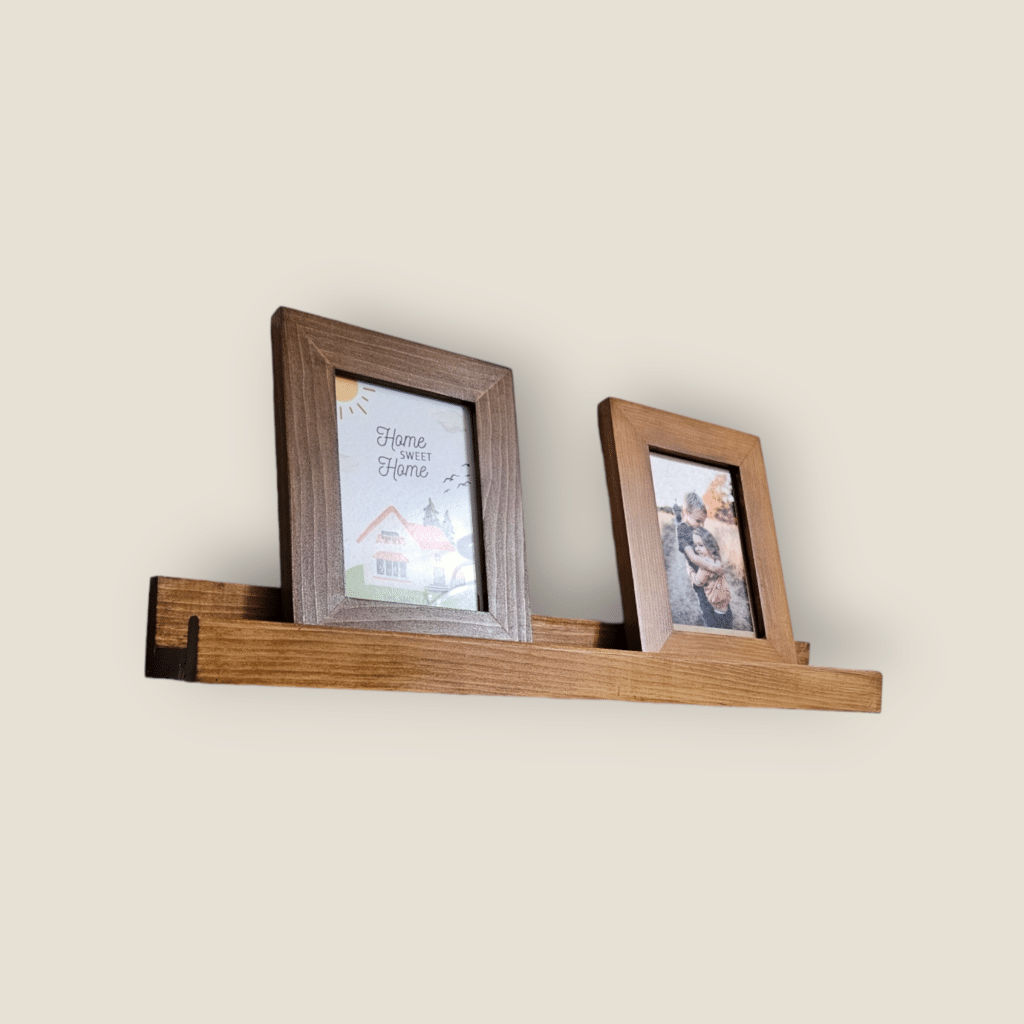
A picture ledge shelf — sometimes called a photo ledge or a picture rail shelf — is a shallow shelf with a small lip or raised edge along the front. That lip is the key feature. It keeps framed photos, small prints, and lightweight objects from sliding forward and falling off the shelf.
The depth of a picture ledge is typically between 3 and 5 inches. It is not designed to hold heavy items or store things out of sight. What it is designed for is displaying — frames, small plants, candles, cards, seasonal decorations. Because the lip holds things in place, you can lean frames at a slight angle rather than hanging them on the wall, which means you can swap them out, rearrange them, and add to the display without touching a single nail.
That flexibility is the main reason people choose a picture ledge over a traditional frame arrangement. A gallery wall of hung frames looks great until you want to change it — at which point you are filling holes and repainting. A picture ledge lets you update the display on a Tuesday afternoon without any of that.
What is a Floating Shelf?
A floating shelf is a flat surface that mounts directly to the wall with no visible brackets. It appears to float — hence the name. Unlike a picture ledge, a floating shelf has no front lip. The surface is flat all the way across.
Floating shelves come in a much wider range of depths than picture ledges — anywhere from 6 inches deep for a narrow accent shelf to 12 inches or more for a shelf that can hold books, kitchen items, or heavier decor. Because there is no lip, items sit flat on the surface rather than leaning against it.
Floating shelves are the right choice when you need actual storage or display space rather than a picture rail. A plant, a stack of books, a candle collection, kitchen spices, bathroom essentials, an audio speaker — these all work on a floating shelf. A picture frame does not lean on a floating shelf the same way it leans on a ledge, so if frames are the primary goal, the ledge is usually the better answer.
The Real Difference — a Simple Way to Think About It
Here is the clearest way to separate them in your mind:
A picture ledge shelf is for displaying things you want to be able to change and rearrange — especially frames. The lip holds them. You can swap a photo in thirty seconds.
A floating shelf is for holding things you want to sit in one place — plants, books, objects, storage. No lip means more versatility in what you put there, but frames need to either hang on the wall above it or sit flat rather than lean.
If someone tells me they want to display family photos and be able to update them without touching their walls — I tell them to go with a picture ledge every time. If they want a shelf that does more — holds heavier things, works in a kitchen or bathroom, doubles as storage — I point them toward a floating shelf.
Which Rooms Suit Each One
This is where the choice usually becomes clear.
Picture ledge shelves work best in:
- Living rooms — particularly above a couch or fireplace where a rotating photo display creates a warm, personal feel without committing to a permanent gallery wall
- Hallways and entryways — a narrow ledge at eye level with a few seasonal frames changes the feel of a hallway without taking up floor space
- Bedrooms — above a headboard or on a feature wall, a picture ledge with a mix of photos and small plants reads as intentional without being overdone
- Kids rooms — perfect for rotating artwork, school photos, and small trophies that change constantly as children grow
Floating shelves work best in:
- Kitchens — open shelving above a counter for spices, oils, small appliances, and everyday items that need to be within reach
- Bathrooms — towels, products, small plants, and storage in a space where every inch counts
- Home offices — books, binders, speakers, and equipment that need to sit flat on a real surface
- Living rooms for heavier decor — sculptural objects, larger plants, and items that need a flat stable surface rather than a leaning position
What About Using Both Together?
This is actually one of the more interesting things you can do with a feature wall and it works better than most people expect. A set of floating shelves at different heights with a picture ledge running below or between them gives you the best of both — dedicated display space for frames at the ledge level and actual shelf space for objects and plants above.
We have had customers in Toronto and Mississauga order a combination — a picture ledge for the main photo display and a floating shelf above it for plants and candles. The ledge holds the frames, the floating shelf adds depth and dimension. It ends up looking like something you would find in a design magazine, but it is not complicated to set up.
Solid Wood vs MDF — Why it Matters More Than You Think
Before you buy either type of shelf from anywhere — including from us — there is one question worth asking: what is it actually made from?
Most shelves sold at large retailers and on marketplace sites are made from MDF — medium density fibreboard, which is compressed wood fibre and glue pressed into a flat panel. MDF looks identical to solid wood in a product photo. It costs significantly less to produce. And it has some real limitations that become obvious once the shelf is on your wall.
MDF does not hold screws the way solid wood does. Over time — especially with any weight on the shelf — the screws can loosen because the material around them compresses. MDF also reacts to moisture, which is a problem in kitchens and bathrooms. It swells slightly when damp, which causes edges to bubble and finishes to peel. And if you ever want to refinish or restain an MDF shelf, you cannot — the surface does not accept stain the way real wood does.
Our picture ledge shelves and floating shelves are built from solid wood. They hold screws properly, they take stain evenly, and they do not swell in a normal residential environment. They are also noticeably heavier when you pick them up — which is usually the first thing people notice when their order arrives. Weight is generally a reliable indicator of quality with wooden shelves.
Our Rustic Wood Picture Ledge Shelf — What We Actually Make
Our picture ledge shelf is built by hand in our Brampton workshop. It has a raised front lip that keeps frames and lightweight objects in place, a rustic finish that suits a wide range of interior styles, and it mounts directly to your wall with the hardware included.
The rustic wood finish comes from the natural character of the wood itself — the grain, the slight variation in tone, the texture that you do not get from a painted or lacquered surface. It works in farmhouse-style interiors, warm contemporary rooms, and anything in between. If your walls are white or warm grey, the natural wood tone sits well against them without competing for attention.
It is the right shelf if you want to display framed photos without hanging them individually on the wall, if you have tried a gallery wall and found it harder to maintain than expected, or if you simply want something on your wall that looks considered and personal without taking an afternoon to set up.
We ship across Canada — all provinces — and to the continental United States. Production takes 3–5 business days. Every order ships with tracking. If you have questions about sizing or whether a picture ledge or floating shelf makes more sense for your specific situation, call us at (289) 499-2822 before ordering. We are happy to help you figure out which one is right.
Quick Reference — Picture Ledge vs Floating Shelf
If you want a fast summary before deciding:
Choose a picture ledge shelf if:
You want to display frames without hanging them. You want to be able to rearrange and update your display easily. Your wall space is in a living room, hallway, bedroom, or kids room. You like the look of leaned frames and layered displays.
Choose a floating shelf if:
You need to hold heavier items or actual storage. Your space is a kitchen, bathroom, or home office. You want a flat surface for plants, books, or objects. You are not primarily displaying frames.
Choose both if:
You have a feature wall you want to do something interesting with and you want a combination of frame display and object display at different heights.
Ready to Order?
Browse our full wall shelf collection at woodartgallery.ca — including our rustic wood picture ledge shelf and solid wood floating shelves. All made to order in Brampton, Ontario. Ships Canada wide and to the USA with tracking on every order.
Questions before ordering? Call or text us at (289) 499-2822 or email info@woodartgallery.ca. We respond within 1 business day.
